
Auto & Manual Motorcycle, Auto motorcycles, Manual motorcycles
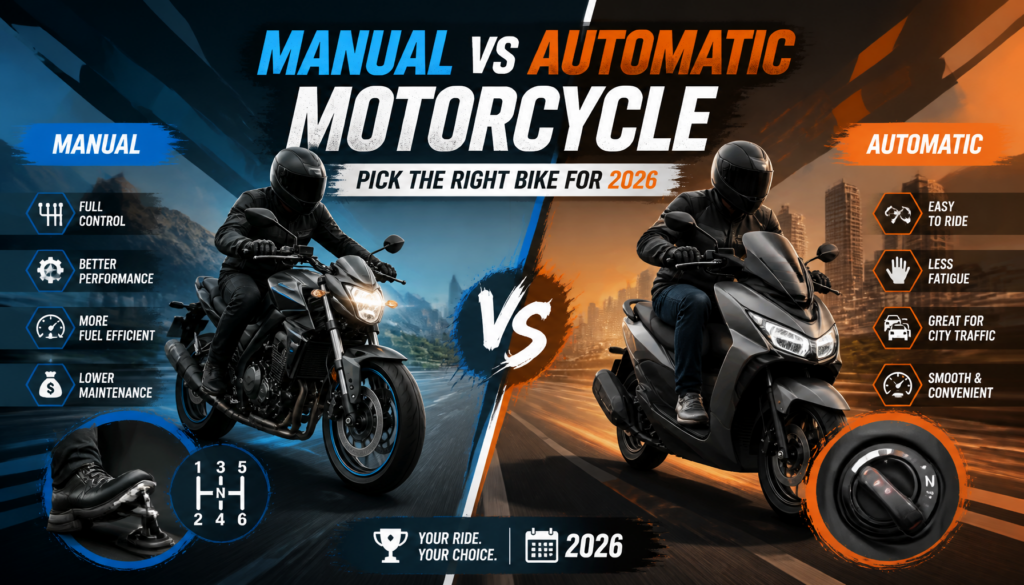
Manual vs Automatic Motorcycle: Pick the Right Bike for 2026
Aug
Manual vs Automatic Motorcycle: If you are torn between gear-shifting and automatic ride styles, understanding Manual vs Automatic Motorcycle can save you time and frustration. Every rider faces this. New 2026 options are wider, and one wrong choice can drain joy from daily rides fast. You may want control, easier traffic handling, or lower stress.
This guide sets out a simple path to compare both options without hype. You will see how each option behaves in stop-and-go streets, during longer rides, and as your skills grow. We will cover comfort, learning curve, maintenance habits, and ownership fit for different budgets and routes. If you are still deciding which is easier to master, we will clear up that confusion too.
We also look at who benefits from each style, based on commute length, road type, and confidence level. Your next bike should match how you ride, not a trend. In the next section, we break down the core differences so you can choose with confidence.
Manual vs Automatic Motorcycle in 2026: Pick the Right One Before You Buy
Manual vs Automatic Motorcycle: In 2026, most buyers are no longer choosing a new bike only by looks, brand, or engine size. The first move is deciding if your route and habits fit the Manual vs Automatic Motorcycle format for your lifestyle, not a dealer showroom trend. This section keeps it practical with a quick framework based on riding experience, realistic budget, and city commute constraints.
A manual motorcycle uses a clutch lever and gear shift control, so the rider manages every gear change. An automatic motorcycle, including common scooter-style CVT designs, handles shifting for you, so you focus on throttle, brake, and line choice. That is why many riders are confused: they assume one system is always better, when in practice they reward different priorities.
| Decision factor | Manual motorcycle | Automatic motorcycle (scooter/CVT) |
|---|---|---|
| Shift control | Requires clutch and gear coordination, giving direct control and a more involved feel. | No manual clutch action, simpler operation in stop-and-go traffic. |
| Learning curve | Steeper, especially for first-time riders who need timing practice. | Usually easier for beginners because gear changes are automatic. |
| City use | Can become tiring in heavy traffic due to constant clutch use. | Often more comfortable for daily commutes with frequent starts and stops. |
| Fuel and efficiency | Can be efficient depending on riding style and model. | Efficiency varies by model and riding conditions, especially city riding. |
| Maintenance and ownership | May offer lower costs in some cases, but gearbox upkeep is part of regular care. | Needs CVT-related service in many cases, and repair cycles differ by model. |
| Riding intent | Favoured when you want more control for varied routes and active rider engagement. | Favoured when you want convenience and less mechanical intervention daily. |
Before you buy, avoid the myth that fuel use or total cost is one-size-fits-all. Both types can fit different budgets once insurance, service intervals, and expected mileage are counted. If legal or practical commuting constraints force repeated parking, heavy stop-start behavior, and short daily rides, convenience may matter more than raw control.
- Start with your commute: if traffic density is high, automatic often reduces fatigue and stress.
- Match your experience: beginners usually progress faster with automatic, while experienced riders often enjoy manual for control.
- Match your wallet: compare purchase price, service costs, and long-term ownership for your specific usage.
- Match your goals: touring, performance, and daily work rides each reward different transmissions.
If you test-ride both styles for your usual route before committing, you reduce buyer’s regret and buy with confidence. In the end, the best choice is the one that fits your routine today and your riding growth over the next two years.
How Manual and Automatic Motorcycles Work
Manual vs Automatic Motorcycle: If you are trying to buy a bike for 2026, the first technical question is not price or style, but how power moves from the engine to the rear wheel. In a Manual vs Automatic Motorcycle decision, knowing the transmission sequence helps you avoid surprises at the traffic lights, on highways, and during long commutes, where different clutch habits can affect comfort, confidence, and fatigue.
A manual motorcycle gives you direct responsibility for shift timing. The core routine is simple: cover the clutch with the left lever, move the gear shifter with your foot to the target ratio, then release the clutch while applying throttle. You also decide when to drop to a lower gear to keep the engine in the right rev range before a hill, an overtake, or a tight corner. That is what riders mean by rider-controlled rpm matching: you are managing engine speed and torque delivery together, instead of letting a mechanism do it automatically.
The advantage is precision. A manual setup lets you decide when torque should be smooth, abrupt, or delayed. For many riders, this translates into better engine braking control and a more involved riding feel, especially when traction changes quickly or when road conditions shift.
Manual vs Automatic Motorcycle: Automatic motorcycles, including CVT and scooter-style belt/variator logic variants, automate the ratio changes for you. In practice, you still keep control of throttle opening and brakes, but the system handles clutch engagement and gear ratio behavior based on speed, load, and engine speed inputs. So the effort split changes: less mechanical coordination work from your hands and feet, more emphasis on smooth throttle and planning ahead.
The biggest practical difference is what stays manual versus what becomes automatic. In automatics, there is no gear lever dance in normal operation, and no clutch modulation at every roll-on or stall recovery. In manuals, your left hand and left foot are part of the control loop constantly, which is empowering for some and tiring in dense stop-and-go conditions for others.
If you live in a market where daily commuting dominates buying behavior, the automatic workflow often fits better with quick errands and dense traffic flow. If you value engagement and fine mechanical control, the manual workflow can feel more natural and confidence-building once learned. Either path is valid; understanding exactly how each system behaves is what helps you pick the right bike for your routes, habits, and long-term comfort.
Quick Specs: Manual vs Automatic Motorcycle at a Glance
Manual vs Automatic Motorcycle: When comparing a Manual vs Automatic Motorcycle, the smart move is to decide what your daily reality demands. In city-heavy regions with repeated stoplights, tight lanes, and tight parking, the right transmission can cut stress. This Quick Specs section translates theory into a fast decision framework so you can choose with less guesswork and less post-purchase regret.
| Criteria | Manual Motorcycle | Automatic Motorcycle |
|---|---|---|
| Transmission type | Manual transmission using a clutch and rider-selected gears. | Automated setup, commonly automatic/CVT-style systems on scooters and some modern commuter models. |
| Rider inputs | Throttle, clutch lever, and gear movement require coordinated timing. | Mostly throttle and brakes; the bike manages shifting automatically. |
| Learning complexity | Higher initial learning curve due to clutch and shift coordination. | Lower complexity and faster ramp-up, making it easier for beginners. |
| Low-speed control | Strong control at crawl speeds once mastered. | Comfortable and simple, though some riders report less fine control in certain maneuvers. |
| Traffic comfort | Can feel tiring in heavy traffic from repeated shifting and clutch use. | Usually calmer and more convenient for stop-and-go city riding. |
| Fuel response | Can be very efficient in practiced hands, though efficiency varies by model and riding style. | Responsive in urban flow, with real-world economy also dependent on route and conditions. |
| Maintenance hotspots | Potentially lower maintenance in some cases, but clutch and gear mechanisms need attention. | Requires routine CVT maintenance, which becomes a key running cost consideration. |
| Typical use-case strength | Long-distance touring, performance riding, and riders wanting direct engagement. | Daily commuting and learner-friendly ownership, especially where traffic is dense. |
Use this chart with your routine in mind. If your commute involves a lot of clutch-heavy stop-start miles, an automatic can reduce fatigue and improve consistency. If your joy comes from shifting, rev control, and direct involvement, you may value manual control more.
From a value perspective, both can be practical purchases, but total ownership is shaped by where you live and how often you ride. Long-term cost comfort usually comes from matching the bike to your actual route, not chasing internet arguments. If your priority is confident entry into motorcycling and smooth city use, start with an automatic; if your focus is control, touring flexibility, and riding engagement, test ride a manual before committing.
Manual Motorcycles: Real Advantages and Trade-Offs
Manual vs Automatic Motorcycle: Choosing between a manual and automatic motorcycle for 2026 often feels like a personality test for your riding style. In a manual vs automatic motorcycle decision, many riders assume one side is purely emotional, but the value difference is mostly practical. A manual puts more decision power in your hand, which matters when roads, traffic, and terrain keep changing every few minutes.
A manual motorcycle gives stronger throttle and throttle-stop control at acceleration, deceleration, and corner entry. For experienced riders, this control can improve confidence when hills, tight corners, or mixed surfaces are part of the route. That engagement is not just about feel; it is about timing your power delivery rather than waiting for an automatic response, which is why skilled riders often prefer manuals for involvement and precision.
There can also be efficiency upside in specific use patterns. When you keep the engine within its best rev range and shift proactively, a manual can deliver better fuel behavior in some riding styles. Ownership logic also helps: many riders find the mechanical layout easier to understand, and straightforward maintenance can reduce uncertainty during routine checks. For buyers who like predictable upkeep and transparency, that simplicity often feels like peace of mind.
Manual vs Automatic Motorcycle: The downside is real and should be faced early. New riders usually face a slower confidence ramp because every stop, start, and crawling move requires coordinated clutch and gear control. In dense stop-and-go commuting, this adds fatigue and concentration demand much faster than expected. If your routine is mostly city traffic with frequent traffic-light waits, the workload can feel higher than many beginners expect.
So the real question is not “manual or automatic” but “what do your first months of riding require?” If you commute through mixed roads, ride long distances, and value direct command, the manual’s strengths may align well with your goals. If your daily reality is beginner-friendly streets, short trips, and quick adaptation under pressure, that learning curve is a bigger obstacle than the mechanical upside. Matching the bike to your actual use case first, then your skills, is the safest path to a purchase you’ll stop regretting.
In short, manual bikes are powerful tools when used intentionally. They reward technique, improve engagement, and can be efficient in the right hands, but they are not the easiest path for everyone. Be honest about your current comfort level, traffic exposure, and time for skill building before you buy.
Automatic Motorcycles: Ease of Riding, Convenience, and Limitations
Manual vs Automatic Motorcycle: For many riders, automatic motorcycles win on practicality long before they matter to track performance, especially in the Manual vs Automatic Motorcycle discussion. The biggest advantage is a smoother learning path: no hand-clutch coordination and no constant shift timing during traffic. If your daily routine includes repeated starts from lights, slow junctions, and unpredictable city flow, the convenience can reduce stress and fatigue, which often becomes the deciding factor when choosing a first bike.
City commuters and beginners often appreciate the way an automatic handles low-speed control. Because gear changes happen for you, there are fewer opportunities for missed shifts or stalled starts, and this is especially valuable in dense traffic where every delay adds pressure. The result is cleaner, less tiring riding during the hardest part of the day: the first and last mile through congestion.
Common advantages you will notice in real-world use include:
- Effortless starts in stop-and-go conditions, which helps reduce rider anxiety.
- Smoother urban ride delivery that keeps attention on traffic gaps and mirror checks.
- Lower coordination demands, making daily commuting more comfortable over long weeks of regular use.
- Less rider exhaustion on short, repeated trips where repeated clutch use can become tiring.
Manual vs Automatic Motorcycle: That said, the trade-offs are real. Some riders feel a loss of direct control in sporty or technical sections because throttle-to-wheel delivery is less interactive than a manual with explicit gear choice. CVT-based automatic motorcycles also bring CVT maintenance into the ownership picture, so service intervals and belt/roller wear should stay on your maintenance calendar. Enthusiasts also report feeling less connected to the machine, as there is no manual gear drama to provide that same physical feedback.
If you mostly ride in traffic-heavy urban areas, your priority is reliability, ease, and confidence, this path is often hard to beat. If your goals lean toward spirited cornering, precision engine braking control, or a more mechanical feel, an automatic may still leave you wanting. Match the bike to your context, not just internet myths: test ride style, compare comfort in congestion, and then buy the setup that supports your real route, license comfort, and long-term motivation to ride.
Cost, Maintenance, and Fuel Economy: Total Ownership Reality
Manual vs Automatic Motorcycle: When you compare a Manual vs Automatic Motorcycle, total ownership cost is less about a single purchase figure and more about how the bike fits your real life. Buyers usually choose by segment first—commuter, urban daily rider, or touring machine—and each segment has its own starting cost band before transmission type is considered. In 2026, the best planning method is to build a budget around three buckets: upfront price, routine maintenance, and eventual wear-item replacement.
In the first 1–3 years of use, depreciation, registration, insurance, and scheduled servicing usually dominate total spend, while major transmission replacements are less common. A model with a higher sticker price can still be sensible if it offers steadier maintenance costs and less rider fatigue in daily use. Over longer ownership, usually beyond three years, that equation changes: recurring maintenance patterns and service complexity start to decide which option is truly cheaper.
Before buying, compare these ownership anchors:
- Segment baseline: set expected spend by intended use (city commute, weekend rides, or longer distance use), not just showroom price.
- Route profile: stop-and-go city riding, mixed roads, or open highways affect fuel and component stress differently.
- Service access: city buyers with quick workshop access may absorb CVT or clutch-related work more easily than rural owners.
Maintenance effort is often where people underestimate cost. Manual bikes reward rider consistency: if you can manage clutch use smoothly, many users report simpler routine care and predictable upkeep. Automatic units are very practical for convenience, but they rely on proper CVT upkeep and correct service intervals, so the local mechanic network matters a lot. If workshop availability is inconsistent, a model that needs specialist handling can quietly become more expensive than expected.
Manual vs Automatic Motorcycle: Fuel economy is also route-sensitive. In heavy traffic and short trips, an automatic can feel less stressful and reduce the tendency to over-rev from constant gear changes. On open roads, a manual machine often gives the rider more direct control over power delivery, which can be advantageous for steady cruising and overtaking confidence. Think of this as a value test: the bike that is “the cheapest to buy” may not be the most efficient in your actual terrain pattern.
For beginners, local buying behaviour in many dense markets tends to value ease of daily commuting, parking stress, and predictable clutch-free control, which can make automatic ownership more comfortable. If you ride farther, crave rider engagement, or plan to keep the bike through multiple ownership stages, a manual can offer stronger long-term control and potentially calmer maintenance confidence over time. In either case, the winning decision comes from matching your commute, your service ecosystem, and your long-term plans—so you buy less on impulse and more on proof of real ownership value.
Which Motorcycle Is Right for You? Manual vs Automatic, Competitor Check, and Local Buyer Concerns
Manual vs Automatic Motorcycle: Choosing between a Manual vs Automatic Motorcycle is mostly about your daily reality, not labels. In 2026, both styles can be smart buys, but only if the transmission matches your routes, legal environment, and tolerance for complexity. Use this quick buyer guide as a decision matrix before you test ride anything.
In a manual setup, you control power delivery through clutch engagement and gear changes, which gives you finer throttle control in varied road conditions. Riders who value engine control, active participation, and potentially lower maintenance in familiar use cases often prefer this setup. The trade-off is real: clutch and gear coordination takes effort, especially during long stop-and-go commutes.
Automatic motorcycles and CVT scooters use continuous transmission behavior, so no manual clutch work is needed. That makes launches, slow traffic, and lane congestion easier for many people. You sacrifice some direct control feel in certain cornering or performance transitions, and CVT-specific maintenance can be more of a consideration if you rely on it daily.
Cross-checking alternatives also helps. A modern automatic is not always “worse” for a beginner than a prior-generation manual setup, but if you already ride a standard manual on weekends, familiarity changes comfort quickly. Likewise, a CVT scooter can cover city errands cheaper to operate, while a manual commuter can still be more intuitive for experienced riders.
- Beginners: If you are learning in city lanes, an automatic motorcycle usually reduces fatigue and builds confidence faster. Pair that with local test rides and confirm your training center or licensing authority accepts the category you need.
- Daily commuters: For nonstop traffic, an automatic is practical and less tiring. If your city has tight parking and narrow lanes, this also helps with low-stress starts and filtering safely.
- Long-distance tourers: A manual can feel more controlled on varied terrain and extended highway runs. But if comfort in heavy congestion is your highest priority, some riders still choose automatic and accept a different riding feel.
- Performance riders: If engagement and shift precision are your focus, manual typically wins for involvement and feedback. Enthusiasts should weigh whether reduced control in an automatic matters more than ease of use.
Manual vs Automatic Motorcycle: Local buyer concerns matter just as much as riding style: helmet and protective gear laws, city traffic rules, and parking or storage limitations often decide the final choice. If your garage is small, a compact automatic or scooter profile may fit better than a taller manual machine. Also check local finance and subsidy options early; some buyers face lower financing flexibility and will prioritize models with easier monthly commitments and predictable maintenance.
For most buyers, the final step is simple: test ride both, compare ownership comfort, and verify legal requirements under your local licensing categories. If you want minimum hassle, choose what keeps you riding safely and consistently. If you value engagement and full control, choose what rewards your skill. Either path is valid when it fits your budget, routine, and local conditions.
Frequently Asked Questions
Are automatic motorcycles worse for fuel economy?
Fuel economy is not fixed by gearbox choice; it depends on route type, rider habits, and bike tuning. In dense city traffic, an automatic scooter/CVT can feel smoother and reduce unnecessary throttle and clutch use, while an experienced rider may optimize a manual better on steadier roads. If you are comparing a Manual vs Automatic Motorcycle option, request comparable real-world usage feedback from your local area and run both styles on your normal route before deciding.
Can a beginner handle manual in city traffic?
A beginner can absolutely learn it, but manual bikes have a steeper learning curve because clutch control and gear selection must be coordinated at every stop and start. In heavy city flow this can feel tiring and slow a rider who is still building confidence. If your first bike will be used mostly for short urban commutes, many riders report automatic is less stressful while they gain experience with traffic behavior.
Which is cheaper to maintain over 3 years, manual or automatic?
There is no universal winner; both depend on usage, service intervals, and local support. Manuals are often associated with lower maintenance in some cases thanks to a simpler manual transmission architecture, while automatic transmissions and CVTs may require dedicated care and parts checks that cost more if ignored. For a realistic 3-year ownership estimate, include routine maintenance labor, parts availability in your area, and warranty coverage when comparing models.
Will a manual be better for highway touring?
For riders who want full power-band control, especially during overtakes, load changes, and long sustained riding, manual control is often a better fit. Automation can still be comfortable for touring when rider preference is smoothness and low effort, but it may feel less engaging for those who like active involvement. Decide whether your priority is control/engagement or ease of use, then match that to your primary riding style.
Do regulations favor one transmission type over the other?
Most riders will not find a global rule that blocks one transmission from legal road use, but local licensing categories, insurance classes, and registration systems can differ. Your safest move is to confirm with the licensing office or transport department whether either type has practical restrictions in your region, especially as a new rider. In metro areas where licensing milestones, parking setup, and theft-safety storage are big concerns, this quick check helps avoid costly changes after purchase.
Our Verdict: Should You Buy a Manual vs Automatic Motorcycle in 2026?
Manual vs Automatic Motorcycle: At the end of this guide, our verdict on manual vs automatic motorcycle choices for 2026 is practical, not ideological: your ideal bike depends on where, how, and why you ride. No one setup is objectively superior in all scenarios. If traffic, routes, and rider confidence are similar, then transmission type becomes a comfort decision, not a status decision.
If you’re a beginner or you’ve taken a long break, choose simplicity first. An automatic or CVT setup removes clutch coordination, which is often the first skill that creates hesitation in dense traffic. In stop-go commuting, that reduction in cognitive load can improve safety because you can focus on mirrors, gaps, and defensive riding.
On the other hand, riders who want a direct mechanical link with the machine often feel more confident with a manual transmission for handling hills, overtakes, and unpredictable road conditions. For performance-focused riding, weekend twisty-road exploration, or long-distance touring with full control over response, manuals usually match the involvement many riders actively seek.
Manual vs Automatic Motorcycle: Costs are where many indecisions persist. Purchase and maintenance economics differ by model and region, so compare total ownership instead of only sticker price. Manual systems can be straightforward to service, while CVT bikes require their own maintenance habits; either path can be cheaper depending on service network, usage, and how long you keep the bike. Fuel efficiency should also be judged by route profile: constant highway speed, hill climbing, and city stop-start all change the outcome.
If your local commute is dominated by congestion, learner-licence stages, and repeated short trips, automatic convenience may translate into less fatigue and smoother daily use. In suburban or highway-heavy zones, the manual option often proves equally or more practical once routine builds, especially for riders who like precise control. Parking realities and storage behavior also matter: when parking is tight and starts are frequent, smooth clutch-free launches can reduce daily stress.
Still, the decisive method is simple and practical: narrow your decision to your top 2 priorities (for example, beginner confidence plus city comfort, or control plus touring ability). Then shortlist bikes by those priorities only, review local service support, and take a short test-ride in both transmission types before purchase. After that one practical comparison, the manual vs automatic question usually resolves itself into a confident choice you’ll enjoy owning.
We at Speedzone specialize in offering top-quality servicing for a variety of premium motorcycle brands. Whether you ride a Yamaha, Honda, KTM, Suzuki, Kawasaki, SYM, Aprilia, Piaggio, or Mutt Motorcycle, you can trust us to keep your ride running smoothly.
Book Your Service Today
Ready to give your motorcycle the care it deserves? Or just curious to know more? With our premium motorcycle accessories available catering to every motorbike models. Book your motorcycle servicing with us or drop by our showroom today and experience the difference of expert servicing tailored to your brand and friendly staffs!
